
SKU: RTPM
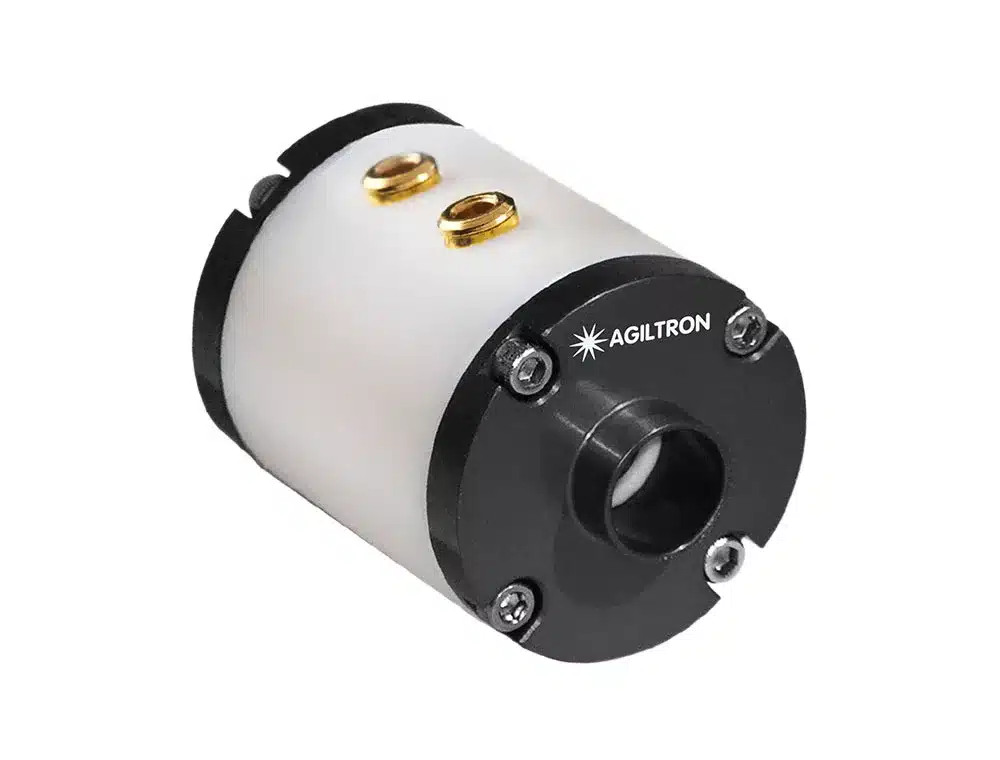
RTP (Rubidium Titanyl Phosphate) crystals offer some of the best electro-optic properties among known materials. Advantages include low driving voltage, no piezoelectric ringing, high optical damage threshold (without gray-track formation under intense laser exposure), high resistivity, a broad transmission range (0.35–3.5 µm), short-wavelength durability, non-hygroscopicity, low insertion loss, and compatibility with high-repetition-rate applications. To ensure long-term thermal and environmental stability, our RTP Pockels cells use a matched pair of crystals to cancel out birefringence drift due to thermal expansion. The electric field is applied perpendicular to the optical axis, which ensures a uniform electro-optic response and minimal distortion of the laser’s spatial mode. These cells operate at low voltage and are available in aperture sizes of 2 mm, 4 mm, 6 mm, and 8 mm. Polarization beam splitter cubes can be aligned and mounted at both input and output ends to configure the device as an intensity modulator. The voltage required to induce a half-wave or a π phase shift (Vπ) in the optical signal is given by the equation: where:
λ is the wavelength of light,
d is the electrode spacing,
n is the refractive index of the crystal,
r is the electro-optic coefficient,
L is the crystal length along the light path.
The Vπ voltage is proportional to the wavelength and inversely proportional to the crystal length.
Optical power handling depends on the clear aperture size and the electro-optic (EO) material selected. Aperture size and crystal length dictate the required drive voltage. Compatible drivers are available on our website. For high-speed modulation, acousto-optic modulators (AOMs) should also be considered.
RTP Pockels Cell Selection Guide
| P/N | Wavelength (nm) | Aperture (mm) | Halfwave Voltage | Price (ea.)* | Buy |
Datasheet | |||||
| RTPM042A | 350-450 | 2x2x12 | 650 | $𝟫𝟨𝟩 |  |
 |
|||||
| RTPM052A | 400-600 | 2x2x12 | 800 | $𝟫𝟨𝟩 | |
|
|||||
| RTPM072A | 600-900 | 2x2x12 | 1120 | $𝟫𝟨𝟩 | |
|
|||||
| RTPM092A | 900-1250 | 2x2x12 | 1600 | $𝟫𝟨𝟩 | |
|
|||||
| RTPM044A | 350-430 | 4x4x12 | 1280 | $𝟣,𝟨𝟫𝟧 | |
|
|||||
| RTPM054A | 400-600 | 4x4x12 | 1650 | $𝟣,𝟨𝟫𝟧 | |
|
|||||
| RTPM074A | 600-900 | 4x4x12 | 2300 | $𝟣,𝟨𝟫𝟧 | |
|
|||||
| RTPM094A | 900-1250 | 4x4x12 | 3200 | $𝟣,𝟨𝟫𝟧 | |
|
|||||
| RTPM046B | 350-430 | 6x6x22 | 1100 | $𝟩,𝟫𝟪𝟪 | |
|
|||||
| RTPM056B | 400-600 | 6x6x22 | 1350 | $𝟩,𝟫𝟪𝟪 | |
|
|||||
| RTPM076B | 600-900 | 6x6x22 | 1900 | $𝟩,𝟫𝟪𝟪 | |
|
|||||
| RTPM096B | 900-1250 | 6x6x22 | 2700 | $𝟩,𝟫𝟪𝟪 | |
|
|||||
| RTPM048B | 350-430 | 8x8x22 | 1280 | $𝟣𝟢,𝟧𝟫𝟩 | |
|
|||||
| RTPM058B | 400-600 | 8x8x22 | 1650 | $𝟣𝟢,𝟧𝟫𝟩 | |
|
|||||
| RTPM078B | 600-900 | 8x8x22 | 2300 | $𝟣𝟢,𝟧𝟫𝟩 | |
|
|||||
| RTPM098B | 900-1250 | 8x8x22 | 3200 | $𝟣𝟢,𝟧𝟫𝟩 | |
|
|||||
| RTPM188B | 1800-2500 | |
|||||||||
| * If the order <5 pc, AR coating lot charge may be required | |||||||||||

Reviews
There are no reviews yet.